Where Agriculture Supports Biodiversity: SIGMA Showcases Practical Solutions at COP17
November 11, 2026
From October 19 to 30, Armenia’s capital, Yerevan, became a focal point for global discussions on biodiversity, bringing together world leaders, researchers, nongovernmental organizations, and private sector actors to advance collective action for nature protection.
The 17th meeting of the Conference of the Parties to the Convention on Biological Diversity (COP17) offered an opportunity to take stock of global efforts, assess progress, and renew commitments to protecting biodiversity.
For the Sustainable Inclusive Growth in Mountainous Armenia (SIGMA) project, which is funded by the Swiss Agency for Development and Cooperation, COP17 provided an opportunity to demonstrate how sustainable agricultural practices can support ecosystem conservation, protect natural resources, and contribute to more resilient rural landscapes.
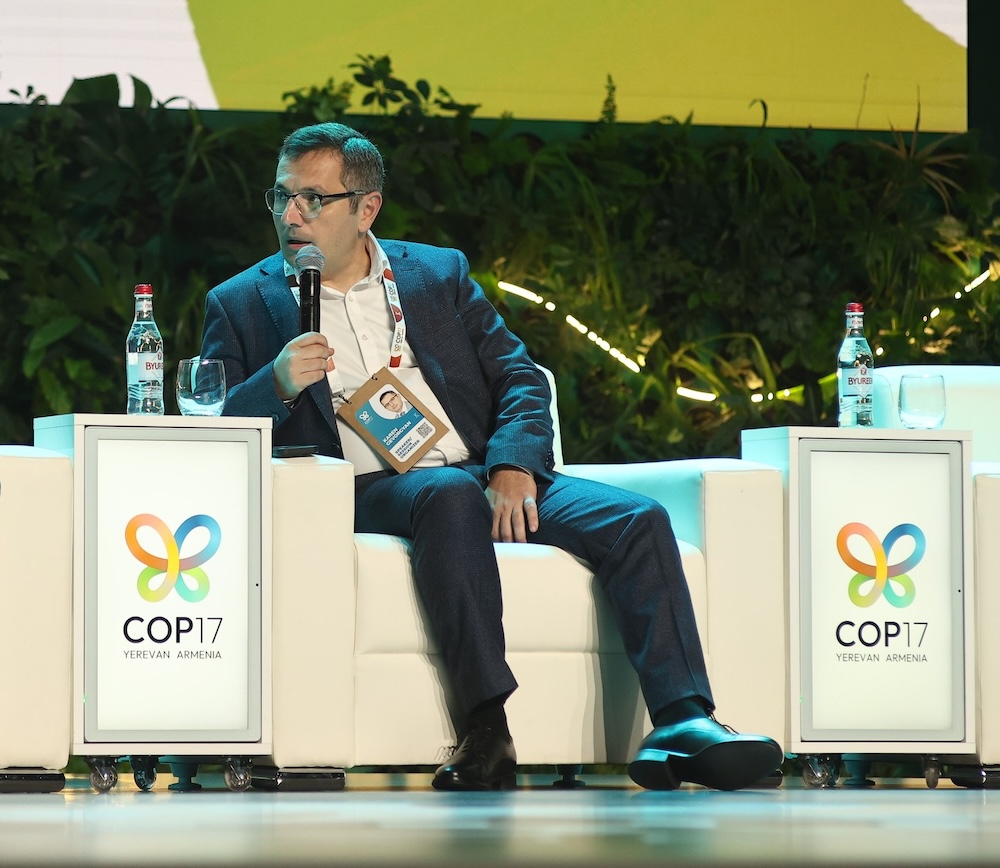
Speaking at a panel on “Biodiversity-Positive Agriculture: Transforming Food Systems for Resilient Landscapes and Sustainable Growth,” SIGMA Team Lead Karen Gevorgyan highlighted how SIGMA’s climate-smart agricultural practices are helping farmers build resilience to climate change while promoting more environmentally responsible production. He also explained how SIGMA’s market systems development approach fosters partnerships among market actors to strengthen value chains and drive behavior change in support of biodiversity-positive agriculture.
A related discussion showed how these approaches are being put into practice. Entrepreneur Anna Altunyan presented a joint initiative with SIGMA, demonstrating how targeted co-investment can help agricultural businesses adopt innovative solutions, improve operations, and strengthen their resilience to climate change.
Through its partnership with SIGMA, Altunyan’s Experimental Garden greenhouse has been able to expand its capacity while adopting more sustainable farming practices. It acquired a solar power system and purchased heating equipment, allowing it to produce healthy seedlings for open-field cultivation and greenhouse production. As a result, the greenhouse recorded its highest sales to date, reaching more than 400 smallholders across Armenia.
Agricultural productivity and biodiversity conservation should be seen as complementary objectives, Gevorgyan and Altunyan said. Building resilient agricultural businesses and value chains while safeguarding the natural resources they rely on is essential for achieving sustainable, long-term growth. Ultimately, advancing biodiversity-positive agriculture requires coordinated efforts, stronger market linkages, and solutions that deliver lasting benefits for both rural communities and the ecosystems on which they depend.
RELATED CONTENT:
DAI Experts Will Present at 7th EU-Africa Business Forum
DAI is pleased to participate in the 7th EU-Africa Business Forum, taking place online from February 14–18.
Read More